
Our History
Lord Baden-Powell
Scouting began with 20 boys and an experimental camp held during the first nine days of August 1907, at Brownsea Island, Dorset. The camp was a great success with tent pitching, use of a map and compass, cooking over a wood fire and tracking.
It proved to its organiser, Lord Baden-Powell, that his training and methods appealed to young people and really worked.
From those earliest days, Scouting flourished with Scouts being recognised for their role during both world wars and continually evolving to become the fantastic youth organisation of today.

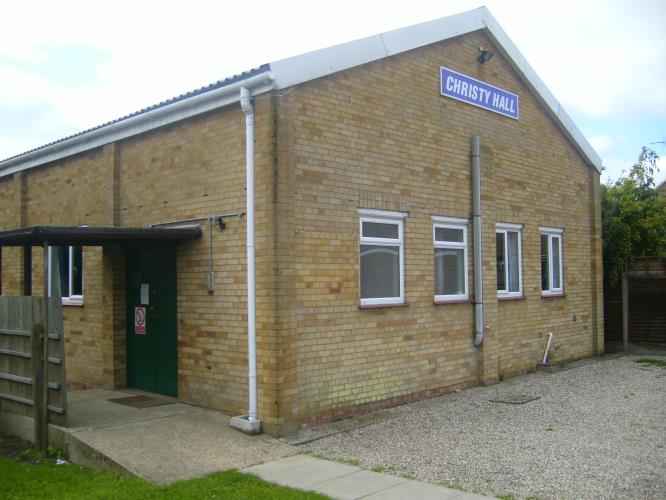
Christy Hall
Violet Christy died in 1985 and a legacy from her estate enabled commencement of the building of the Christy Hall Scout & Gude Headquarters which was subsequently constructed using entirely parent volunteer labour after considerable fundraising efforts. The building was completed some 15 years later in 1960.
A SHORT HISTORY OF SCOUTING IN INGATESTONE
Scouting began when Robert Baden-Powell held an experimental camp for 20 Boys during the first nine days of August 1907 on Brownsea Island in Poole Harbour, Dorset.
Baden-Powell had only intended to provide a method of training boys for The Boys Brigade and the YMCA, but to his great surprise the camp proved to be such a big success that youngsters started to organise themselves into what was destined to become the world’s leading voluntary youth organisation.
In January 1908, Robert Baden-Powell published the first edition of ‘Scouting for Boys’ which was issued in fortnightly parts at 4d each and in April 1908 the introduction of ‘The Scout’ – a penny weekly magazine was to provide an important link for the rapidly increasing number of boys who were joining together all over the Country to form themselves into Patrols of Scouts.
By the Autumn of 1908 several “Boy Scouts” were meeting in Ingatestone with Mr Archibald Christy as their adopted “Scout Master”.
The following article appeared in “The Newsman” newspaper on 6th February 1909
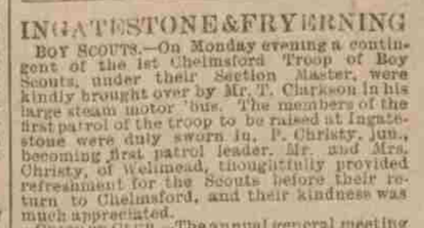
BOY SCOUTS – On Monday evening a contingent of the 1st Chelmsford Troop of Boy Scouts, under their Section Master, were kindly brought over by Mr.T.Clarkson in his large steam motor ‘bus. The members of the first patrol of the troop to be raised at Ingatestone were duly sworn in. P.Christy (jun) becoming the first patrol leader. Mr and Mrs Christy of Wellmead thoughtfully provided refreshment for the Scouts before their return to Chelmsford, and their kindness was much appreciated.
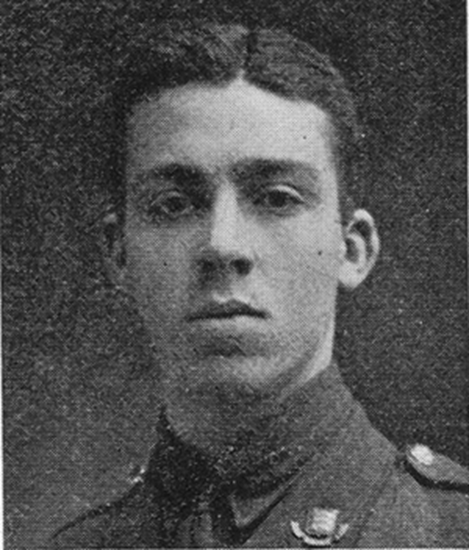
The first Patrol Leader in the 1st Ingatestone Scout Troop was one Phillip Christy (son of Archibald) who in November 1912, aged just 16 years old, was gazetted to the Special Reserve of the Essex Regiment and, at the outbreak of the 1st World War was posted to the 2nd Battalion the Essex Regt and found himself in France with the BEF on August 19th 1914 just 16 days into the war, where he fought at the Battle of the Aisne and in Flanders.
In January 1915, still only 19 years old, he gained permission for a scheme to drain the trenches of water. His company was relieved on 7th Feb, but he asked to stay on for two more days and on the morning that he was due to leave he was killed by a sniper.
Phillip Christy is buried at Fryerning Church and there is a commemorative memorial plaque inside the building.
On the 30th September 1912 the Ingatestone & Fryerning Local Association – covering the area of Ingatestone & Fryerning (later to be extended to include the villages of Mountnessing & Margaretting) was registered in the Essex District of Mid Essex and Romford
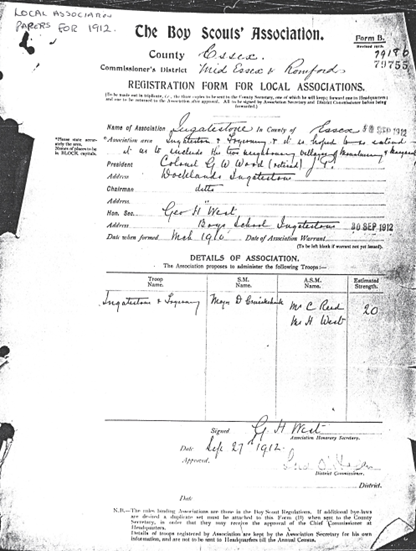
We can see from the above document that the initial formal registration of the Group was in March 1910 and that the Scout Master at the time was Major D Cruickshank assisted by Mr C Reed and Mr H West. There were 20 Scouts.
In March 1917 Archibald Christy’s daughter Violet Christy (Phillip’s sister) started a Wolf Cub Pack in Ingatestone and became a lifelong Scouter held in high esteem throughout the County holding various ranks including Commissioner for Special needs.
Registration of Boy Scout Troops (and Wolf Cub Packs) did not commence at National Headquarters until 1st October 1919 and on that date the 1st Ingatestone & Fryerning Boy Scout Troop and Wolf Cub Pack both affected separate registrations (being No 1290 & 522 respectively)
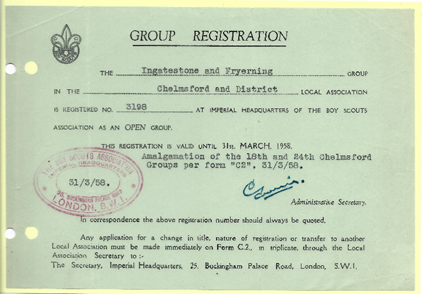
The Troop and the Pack were re-effected as a Group registration on 12th November 1928 when the present system of Group registrations was introduced and the present Registration No of 3198 was allocated.
On 31st August 1938 the Group was transferred from the Ingatestone and Fryerning Local Association to Chelmsford and, at an unknown date the Group title was changed to the 18th Chelmsford (Ingatestone & Fryerning)
On 31st March 1958 the Group was amalgamated with the 24th Chelmsford (2nd Ingatestone) to form the 1st Ingatestone & Fryerning Group retaining it’s original registration No 3198 and has continued in existence since then with no breaks and no further changes in registration.